

UV self-cleaning water bottle feature a small ultraviolet-C (UV-C) light in the cap to reduce bacteria present within the bottle. For business, these water bottles can serve as wellness benefit, a premium gift, or a product line for resale. From FMI Self Cleaning Bottle Market, sales of UV self cleaning bottles are projected to expand at a 7.1% CAGR between 2026 and 2036.
This guide explains how the technology works, where it fits, and what to check before you place a bulk order.

Self-Cleaning Bottle Market Value Analysis | Source: Future Market Insights, Inc.
What Is a UV Self-Cleaning Water Bottle?
A UV self-cleaning water bottle is a reusable bottle that have a built-in UV-C LED light installed in the cap and facing downwards into the bottle. After turning it on, it exposes the inner surface and water to the UV-C light, which is known to disrupt the DNA of bacteria and some viruses.
Double-wall stainless steel is a common material for most model, making them capable of keeping drinks cold or warm. Battery is built into the cap, and it can be charged via a USB-C cable. Most bottles will start sanitizing process automatically every few hours, and also allow users to turn on manually.
Term “self-cleaning” is a marketing term. It means the bottle is able to sanitize itself between washes. But it does not mean that the bottle will not require washing by hand at all.
How UV-C Cleaning Works
There are three primary types of UV light: UV-A, UV-B, and UV-C. Among these, UV-C is mainly used for the disinfecting purpose. Its wavelength ranges from 200 to 280 nanometers. For decades, hospitals, water treatment plants, and labs have used UV-C light in order to treat air, water, and other surfaces.
Inside a bottle, UV-C LED light works in a short cycle, often 60 seconds for a quick sanitizing and several minutes for a more comprehensive one. Many manufacturers that sell these bottles state that they can eliminate up to 99.9 percent of bacteria found inside a bottle. However, this number just as a starting point because it depends on these factors: LED power, bottle shape, water quality, and duration of the cycle. Ask for third-party test reports instead of relying on a product page.

Why Businesses Are Paying Attention
The market for UV self-cleaning water bottles comes from three commercial considerations: employee wellness, branded merchandise, and retail sales.
Employee wellness and workplace programs. Many companies already offer reusable bottles to minimize usage of single-use plastic. A bottle that also helps keep its inside cleaner adds a health message to a sustainability one. HR and facilities teams can use it in wellness kits, onboarding packs, or return-to-office campaigns.
Corporate gifting and events. A pen or a tote bag is easy to forget. A tech-enabled bottle is more premium, gets used daily, and keeps your logo in front of the recipient for years. It works well for client gifts, conference giveaways, and employee anniversary awards.
Retail and distribution. There are many more consumers search for terms like “UV self cleaning water bottle” every year, and the product is placed in a price range higher than that for regular insulated bottles. This provides retailers, e-commerce sellers, and promotional product suppliers with improved margins provided that quality is consistent.
Other buyers include gyms, hotels, schools, and travel companies, who want to offer a cleaner-feeling drinking option to their members or guests.
What to Check Before You Buy
Not every UV bottle is built the same. Before ordering in bulk, review these points with your supplier:
- UV-C wavelength and output. Ask for the LED specification and whether it is in the germicidal range, around 260 to 280 nm.
- Safety features. The light should switch off automatically when the cap is removed, so users are never exposed.
- Test reports. Look for independent lab results that name the bacteria tested, the cycle time, and the reduction rate.
- Battery and charging. Check battery life per charge, charging time, and whether the cap is sealed against splashes.
- Materials. Food-grade 304 or 316 stainless steel and BPA-free seals are standard for quality bottles.
Apart from the list, consider the practical aspect of purchasing. Test a sample of units by yourself before making your decision. Fill them, run the cycles, drop them, wash them, and see how they hold up after a few weeks of use.

Limits You Should Be Honest About
A clear, honest message will preserve your brand. There are limitations to UV-C sanitation, and your marketing should reflect them.
First, UV light only treats what it can reach. It can be harder to cover the corners, threads, or the bottom of the cap sanitized. Second, UV-C light cannot help with cleaning out dirt, residues, or biofilm in the inner surfaces of the bottles. A bottle with beverages like sugary drinks or protein shakes still needs regular washing manually. Third, UV-C light not a replacement for purified water. It is a sanitizing aid, not a full purification system, unless the product is tested and certified as one.
Lastly, avoid health claims you could not prove. Expressions such as “kills all germs” or “protects from illness” can create legal and reputation risks. Use only those expressions that are supported by the reports, such as “helps reduce bacteria inside the bottle.”
Cost and Return on Investment
UV self-cleaning bottles cost more than standard insulated bottles. Unit prices vary widely based on order size, battery quality, and customization. Because of the added electronics, expect a noticeably higher unit cost than a basic steel bottle.
The return depends on how you use them. For a gifting program, the value comes from daily use and brand visibility over several years. For a retail line, it comes from higher selling prices and repeat buyers. In both cases, quality matters more than the lowest price. A cheap bottle with a weak battery or a leaking cap can hurt the reputation of the brand printed on it.
It also helps to count the full lifecycle. A well-made bottle that lasts several years and replaces dozens of single-use bottles supports sustainability reporting, which many companies now track.
Customization and Branding Options
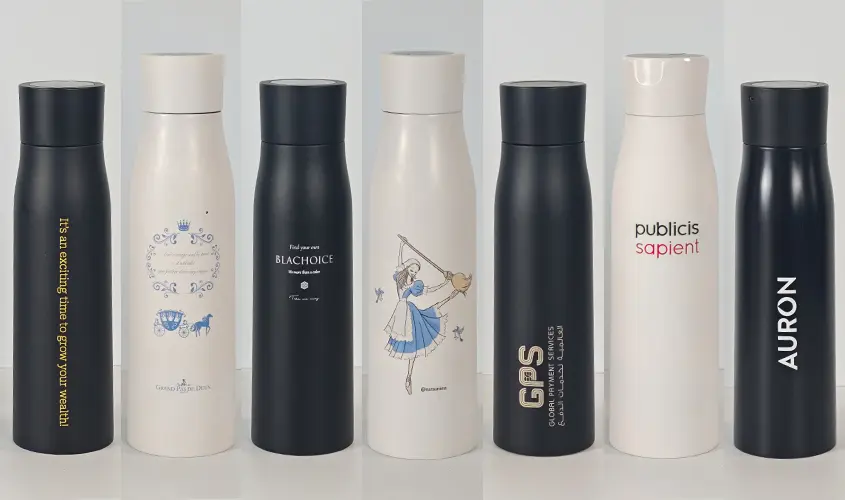
Most suppliers offer laser engraving, screen printing, and custom color coatings. Engraving tends to last longest on stainless steel. You can also customize the packaging, the charging cable, and the user guide.
Plan your artwork early and ask for a physical proof before full production. Minimum order quantities often start at a few hundred units, though some suppliers allow smaller test runs.
Compliance and Safety
Because the product contains a battery and a UV light source, check that your supplier can provide the right paperwork for your target market. In the United States, buyers commonly look for FCC compliance for the electronics and food-contact safety documentation for materials. In other regions, CE marking and RoHS may apply. Battery shipping rules also matter, since lithium batteries have transport requirements for air and sea freight.
Ask your supplier for copies of certificates, and confirm that they match the exact model you are buying.
How to Choose a Supplier
A good supplier answers technical questions clearly and shares test data without delay. Ask about their quality control process, defect rates, warranty terms, and lead times. Request references from other business customers if possible. Finally, confirm after-sales support, such as replacement caps, since the cap is the part most likely to need service.
Final Thoughts
A UV self-cleaning water bottle offers a practical mix of hydration, convenience, and a modern health message. For businesses, it can support wellness programs, strengthen gifting campaigns, and add a higher-value product to a retail range.
The key is to buy with care. Check the UV-C specifications, ask for independent test results, confirm safety and compliance, and keep your marketing claims accurate. Start with samples, review the quality, and then scale your order. Done well, a UV self-cleaning water bottle can be a product your customers and employees use every day and trust.
Mountop Bottle is a manufacturer of professional water bottles based in Shenzhen, China. The company was founded in 2008 and focuses on providing OEM and ODM water bottles projects to wholesalers, distributors, retailers, and brands.
The factory offers stainless steel water bottles, smart water bottles, UV water bottles, plastic sports bottles, shaker bottles and other types of water bottles. Mountop also offer customization services, inclued logo printing, private label solutions, product design and development, mold creation and packaging customization.
With an experienced production team and in-house manufacturing capabilities, Mountop supports both simple logo customization and fully customized product development.


